
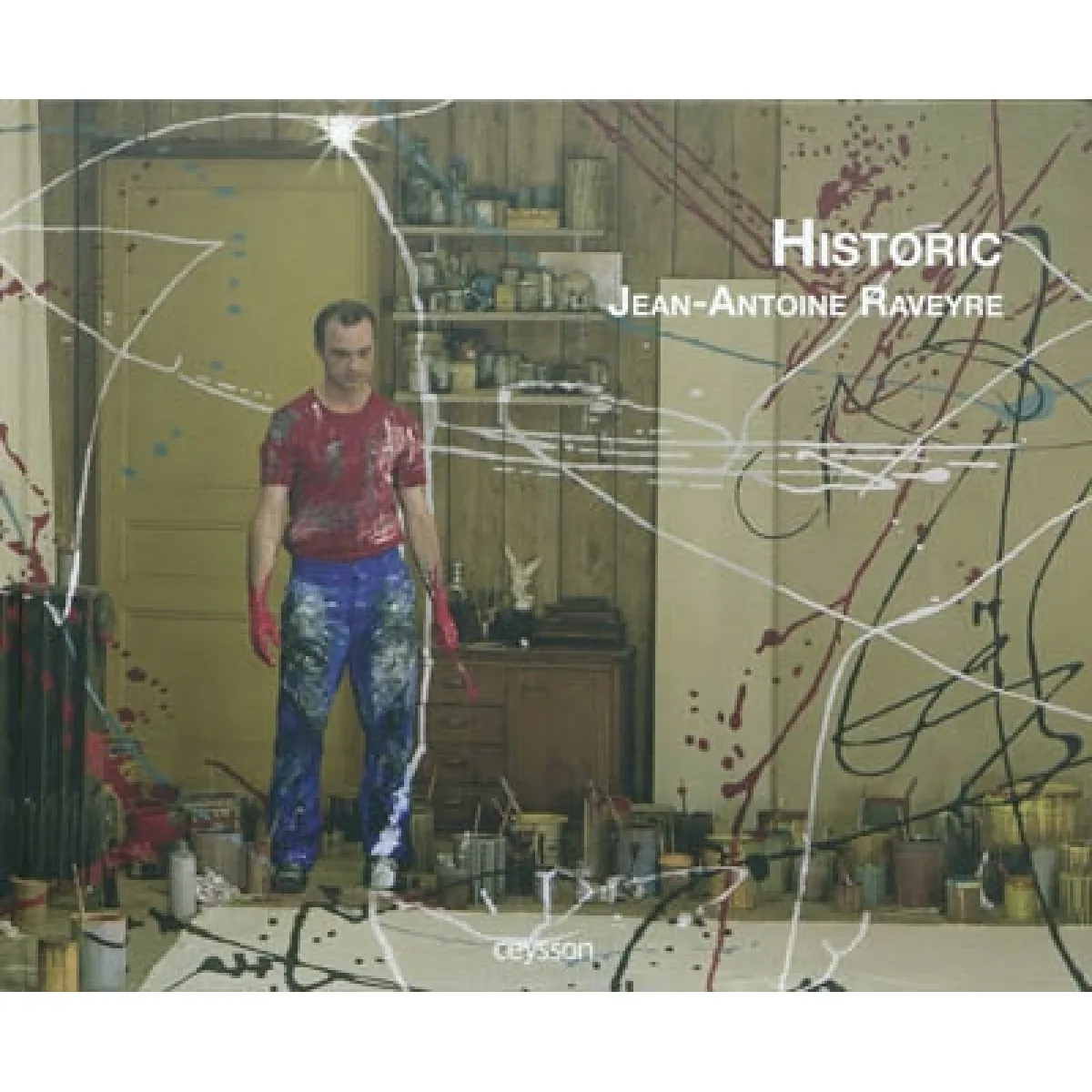

Quatrième de couverture : Essay by Alexis Jakubowicz Raveyre, Flash-Forward The pictures Raveyre took after 2009 are in line with Michael Fried's project Contre la théâtralité : Du minimalisme à la photographie contemporaine. The inaugural work of Raveyre's modernism, if one may call it that way, is a tribute to Jackson Pollock's art, also celebrated by Clement Greenberg and Michael Fried. With The End (2009), used as the book cover, the photographer shows that he can meet the requirements of frontality in a Euclidean space. Rosalind Krauss suggested that the flatness in Pollock's paintings was a result of the interlacing lines denying the relation between the figure and the content and preventing the corporeal projection of the spectator. Krauss believes that Pollock's paintings convey literal impenetrability. Jean-Antoine Raveyre produces the same effect by taking dripping in the depth of a setting. It is almost impossible to figure out that the drips of paint in The End are really painted in three dimensions. The photographer could have obtained the same result by projecting the paint on a glass plate, and photographed the scene through the glass plate. But he did net, because he is a virtuoso, blocking the spectator's look in the conditions required by Modernism, while solving frontality in space with however four meticulous exceptions : the projections, if one looks closer, are behind the character, the globe on the shelf on the left, the skull, and the key on the right. These suspended objects challenge Greenberg's theory that leaves out in principle the meeting of arts. For Greenberg, who sought to define kitsch, Painting and Sculpture must be based on specific qualities - flatness for Painting, and volume for Sculpture. With The End, not only does Raveyre introduce Painting in the space of Sculpture, but he does it with a photographic intention. He contravenes the prescriptions of Modernism white reproducing its effects.
Votre panier
Toutes les commandes sont en cours de traitement
USD.
Le contenu de votre panier s'affiche maintenant dans
CYN,
vous vérifierez lors de l'utilisation
USD
au taux de change actuel
En rupture de stock
Certains articles ne sont plus disponibles. Votre panier a été mis à jour
Avez-vous un code de discount ?

Pourboires

Assurance d'expédition
Subtotal
Discount
Ce code de discount ne peut pas être utilisé ensemble avec d'autres offres promotionnelles ou de discount
Total
Les taxes et les frais d'expédition calculés à la caisse
Commentaire